|
|
Red Dawn: Mao Spins the Cultural Revolution
BY GERALD PEARY, Boston Phoenix, October 17 - 23, 2003
Richard Gordon and Carma Hinton, the directors of Brookline's
Long Bow Group, are responsible for one of the seminal political
documentaries of the last decade,
The Gate of Heavenly Peace
(1995), a complex, powerful retelling of the 1989 massacre at
Beijing's Tiananmen Square, for which they interviewed key
surviving student demonstrators. Morning Sun, which is
showing over the next two weeks (October 17-19, 22-25, and 30-31
and November 1) at the Museum of Fine Arts, is a prequel to the
above, for which Gordon and Hinton added on a third director,
Geremie Barmé, a historian of Maoist and post-Maoist
China. Even with three filmmakers, the task at hand is a
formidable one, and it is mostly achieved: to make sense of
China's Animal Farm-like Cultural Revolution, 1964-1976, when
Mao consolidated his power and rid China of his
"counter-revolutionary" enemies, real and imagined,
with the enthusiastic, sometimes murderous, help of China's
student population.
"You young people are like the morning sun," Mao said,
playing to the egos of high-schoolers and college kids.
"Hope is pinned on you." When he appeared among them
in Tiananmen Square 1964, walking through the youthful crowds,
they giggled and screamed as if it were the Beatles at Shea
Stadium. He took their side when they rebelled against their
teachers and administrators, saying how he disapproved of pop
quizzes and how, if an instructor were boring, he too would
sleep in class! What a great guy, Chairman Mao! When
anti-authority students formed what they called "Red
Guard" units, he allowed it. And when the Red Guards turned
violent, he approved. Soon there were Red Guard groups all over
Beijing, and with Little Red Books clutched in hand, they were
chomping at the bit to do Mao's bidding.
If you believe in the idealism of youth, much of
Morning Sun is drearily depressing and heart-wrenching.
How did all those nice young people fall so completely for Mao's
devious, homicidal power-mongering? Isn't it so obvious that his
revolution for the proletariat is patently fraudulent? The films
and photographs from the period, however familiar, remain
devastating: snorting, angry mobs of students attacking
so-called "class enemies," forcing old and frightened
people to their knees, punching them, humiliating them,
sometimes killing them. With the endorsement of Mao.
The filmmakers interview a handful of now middle-aged, and
much-chastened, Chinese people who were zealous Communist
students in the early 1960s. One was an original Red Guard who
quickly turned pacifist when his peers started bloodying people.
Another had her 15 minutes of fame after she boldly placed a red
armband on her hero: Mao himself. Years later, she's an
anti-Maoist, as is everyone who's talked to. Several of the
interviewees were among the tortured, or were sent into exile
for their alleged bourgeois tendencies.
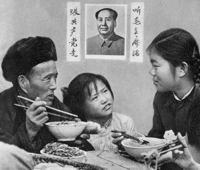
Morning Sun includes chunks from a series of Maoist-era
movies, prime Marxist-Leninist texts. The key film, a Chinese
Gone with the Wind, is East Is Red, a filmic
recording of the all-singing-dancing cast-of-a-thousand theater
spectacle that played in 1964 at the Great Hall of the People in
Beijing, honoring the 15th anniversary of the Chinese
Revolution. It's a "Holiday on Ice" sans ice, with
choreographed soldiers and peasants and workers leaping
heroically about the stage in hero worship of Mao. The schlock
show concludes as it must: the orchestra leader turns toward the
audience and everyone, on stage and off, joins in a rousing (and
required) singing of the Internationale.
But East Is Red is nothing, nothing at all, next to a
Maoist pseudo-documentary (has anyone in the West ever before
seen this perverse film?) about a school for the deaf and dumb.
We watch these children get fitted for hearing aids; the next
thing you know, 105 regain their hearing. Thanks to the caring
Chairman. "Their love of Mao knows no bounds," says
the gushing voiceover. And what can they do for Mao? Join him in
his hatred of his one-time second-in-command, his Trotsky, Liu
Shaoqi. The latter is "the enemy of the proletariat and
deaf mutes," says the bitter voiceover.
Black humor? Morning Sun traces down Liu's adult
daughter, who tells us of his tragic fate. Denounced by Mao, and
by the Ninth Party Congress, he died in 1965 in exile, of
pneumonia, stripped of all clothes.
Do you know these incredible things about Communist China?
Become about a thousand times better informed: see
Morning Sun
in its MFA run.
http://www.bostonphoenix.com/boston/movies/film/documents/03232423.asp
|