|
|
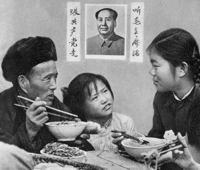
Morning Sun: The bizarre and colorful nightmare
world of Chairman Mao's Cultural Revolution comes alive in an
extraordinary new documentary.
Smash the Old World!
By Charles Taylor, Salon.com, Oct. 22, 2003
At moments, watching the superb new documentary "Morning
Sun" (now playing at Film Forum in New York and the Museum of
Fine Arts in Boston) suggests what it might be like to see
atrocities rendered as oil paintings on black velvet. Two of the
directors of this film about Mao Zedong's Cultural Revolution, which
aimed to rid China of Western capitalist influences, Carma Hinton
and Richard Gordon, are the team that made the great 1995
documentary "The Gate of Heavenly Peace" (Geremie R. Barmé is the third director here). Hinton
was born in China in 1949, the year Mao came to power, and lived
there until 1969, and that may have much to do with the amazing
access the filmmakers have to archival material and to the key
figures who are interviewed.
Even though the century just past accustomed us to the grotesque
lies of totalitarian propaganda as they appear in newsreel footage
and "official" newspapers, the monstrous kitsch that
recurs throughout "Morning Sun" to glorify Mao’s
rise and justify the mass denunciations and killings of the Cultural
Revolution is flabbergasting. When you see footage of the 1964
musical extravaganza "The East Is Red" staged at the Great
Hall of the People to celebrate the 15th year of Mao’s rule,
you feel like you’ve fallen down the proverbial rabbit hole.
Remember those Hollywood musicals that climaxed with a big stage
show so massive we realized it could never take place in an actual
theater? "The East Is Red" is that big, and we’re
seeing it acted out in front of an audience. An entire Communist
choir stands to one side of the stage while seemingly hundreds of
performers move across it, acting out moments from Mao’s quest
to rule China. The singers step forward to perform numbers whose
lyrics all appear to have been taken from Mao's doggerel poems or
aphorisms.
Seeing the hearty smiles on their bland, confident faces is like
having the most homogenized strain of American movie musicals
reflected back at us in a sinister new form. It's what you might
expect to see if Angela Lansbury had been triumphant at the end of
"The Manchurian Candidate" and staged the inaugural ball
as a celebration of the Chinese Communist struggle. When ballerinas
in Mao outfits sprint, en pointe, across a woodland set, we're
watching something that might have been produced by Metro Goldwyn
Mao: "Seven Red Guard Soldiers for Seven Reactionary
Counterrevolutionaries."
History as spectacle—as predetermined narrative, as
performance—is the controlling metaphor of "Morning
Sun." What plays out before us is a tale of the acceptance of
mass delusion and mass hysteria. Mao, under unexpected criticism
because the economic policies of the Great Leap Forward had been so
disastrous, blamed those who worried about the mass starvation with
being more concerned with economics than politics, with wanting to
dilute a pure socialist state and open itself to
imperialist/materialist/Western influence. What he proposed was an
upheaval that would purge the very minds and culture of China, that
would admit only the socialist purity he wanted, in which any
recidivism would be a cause for public denunciation. First to go was
Western literature and music and performances. Then, Communist Party
officials themselves. His most useful tool was the young, especially
the university students wanting to fulfill their revolutionary
potential, even if it meant disowning or denouncing teachers, family
members, friends.
So "Morning Sun" becomes a sort of a fairy tale, a story
of children (Chinese youth and university students) coming under the
influence of an all-powerful wizard (Mao), except that in this
version the wizard is the good guy. Listen to the lexicon of Maoist
iconography: the Long March, the Great Leap Forward, the Great Hall
of the People. It’s mythomaniacal language designed to
propagate its own legend. The propaganda musicals and dramas we see
produced by the Chinese film industry (one in particular, in which a
working-class boy's materialist corruption is foretold by his
admiring the cut of a new jacket) are as leaden and grotesque as you
might imagine. In the context of the movie, they cut deeper than the
newsreel footage narrated by a chirruping female voice proclaiming
the greatness of Mao. (That's some feat, considering that one of the
newsreels we see tells how a school of deaf children had their
hearing restored by coming to understand the philosophy of their
beloved leader. I'm not making this up.)
The footage has that effect because we are watching the story of
people who took such shallow, banal things as signals for
revolutionary action, which meant public denunciations followed by
exile, public beatings and execution—millions died in the
Cultural Revolution. It all illustrates one of the contradictions of
Communism: the way Marxist ideology, which is anti-religious,
morphed in its official version into its own religion, inspiring a
crusading fervor few modern religions achieve.
Interspersed among the footage are interviews with the people who
slipped the confines of the fairy tale Mao was imposing on China.
They include the student founder of the Red Guard, Luo Xiaohai, who
became appalled at the violence the Cultural Revolution inspired;
Song Binbin, whose name, meaning 'gentle and refined," was
rechristened by the press "Song Be Militant" when Mao said
to her, "Better be militant"; Li Nanyang, who struggled
for years to prove herself a good communist, even rejecting her
father, Li Rui, a former party official who was disgraced after
denouncing the economic policies of the Great Leap Forward; and Wang
Guangmei and Liu Ting, respectively the widow and daughter of
President Liu Shaoqi. In exile and in poor health, he was kept alive
for the Ninth Party Congress in 1969 to prove the existence of
enemies to the state and allowed to die of pneumonia shortly
thereafter. Wang Guangmei was publicly ridiculed and denounced
during the Cultural Revolution (we see film of her dressed in a
humiliating costume before students who heap abuse on her) and
jailed for many years.
These people speak as those who have awakened from a bad dream.
Maybe one of the reasons they agreed to be interviewed for the film
is that they have all been wronged themselves. That doesn't mean
they appear before us to let themselves off the hook. You never get
the sense, as you do listening to some of the collaborators in
Marcel Ophüls' Holocaust documentary "The Sorrow and the
Pity," that they’re trying to cover their tracks or
substituting justification for explanation of their actions. You do
sense people who existed in a nation swept up into a fever dream,
where resistance meant at best incredible hardship, and quite
possibly death -- not just for them but for their families as well.
Because all of the interviewees are so thoughtful and eloquent, we
get a sense of how hard it was for them to suppress their doubts,
and of the guilt those doubts caused them -- the suspicion that they
themselves were backsliders.
The tension playing itself out in "Morning Sun" (the title
comes from Mao's dictum that the young are like the morning sun,
"the hope of the future") is the tension present in any
revolution between inclusion -- the belief that revolution will
sweep everyone into supporting it -- and the desire to maintain
purity. One of the interviewees, Yu Luowen, had an older brother, Yu
Luoke, who wrote an essay saying that the children of "bad
families,' in other words, the families deemed reactionary or
capitalist, had as much right as anyone else to take part in the
revolution. The essay won initial approval. What revolutionary
doesn’t want to believe that anyone can be won over by a
revolution's truth? But "Morning Sun" shows how attitudes
were mercurial, and Yu Luoke was arrested and shot. Luowen tells us
that when soldiers came to inform his father what had happened, they
reacted in disgust to see his father break down wailing. Li Nanyang
relates an incident declaring to her classmates the infraction of
calling her father, deemed an enemy of the state,
"Dad."
Mao, whose visage seen throughout the movie is that of a fat,
sedentary tomcat who'd scratch your eyes out at the slightest
provocation, was the only father any child obeyed during the
Cultural Revolution, and "Morning Sun" shows how the
Revolution was the strongest expression of the cult of personality
that surrounded him. His purging of many Communist Party officials
was an obvious move to consolidate his power. But it also had the
purity of revolutionary logic -- that is, the purity of something
ready to eat itself alive. Disobedience to the party was a crime,
unless it was disobedience or questioning of those whom Mao had
branded traitors to the Revolution.
It would be enough if Hinton, Barmé and Gordon had made a
movie that is consistently lucid, one that supplies all the
information you need at any given moment. They are also among the
most humane of documentarians, never pushing their interviewees,
allowing them the space to present themselves, extending them the
empathy of understanding how easy it was to get caught up in
Mao’s crusade. And they manage the trick of making their films
aesthetically pleasing without blunting their force as historical,
human or political documents. There's a brilliant section here
intercutting a scene from "The East Is Red" with the same
incident dramatized in a propaganda film. It's the most concise
expression of this film's sensibility -- the sense that real life,
real history, has gone into hiding, and only representations can be
compared.
"Morning Sun" ends abruptly, with a few lines of narration
setting out the paradox Mao represents for China: He is an
ever-present image who stands for past tyranny but also for the
possibility of rebellion. Whether that rebellion will be for good or
another outburst of the nightmare of the Cultural Revolution, the
filmmakers cannot say. The story they are telling here is still in
the process of being written. It’s as good a sign as any of
how absorbing "Morning Sun" is that the film's sudden
ending makes you greedy for more, for the balance of discernment and
empathy that is their gift to contemporary documentary
filmmaking.
- - - - - - - - - - - -
About the writer
Charles Taylor is a
Salon
contributing writer.
|