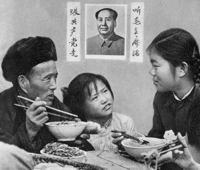
Lei Feng's Immortal Spirit
NEW-OLD ROLE MODEL
Peking propagandists bring back their '60s hero: Lei Feng
March 6, 1987
Julian Baum, Staff writer of
The Christian Science Monitor
In a flashback to a 1960s propaganda campaign, the
"glorious name of Lei Feng" has been revived as a
role model for Chinese youth.
Mao Tse-tung penned his famous inscription "learn from
Lei Feng" 24 years ago yesterday, and China's leading
newspapers carried commentaries memorializing the young
military driver from Hunan Province who was made into a hero
for helping to construct socialism.
This week, banners on Peking streets and posters in buses have
appeared, saying "learn from Lei Feng." A few young
people from communist youth organizations have manned street
booths, symbolically serving the people.
Observers say the revival is another sign of the more
conservative political style that has characterized the
Communist Party leadership since January.
The so-called "spirit of Lei Feng" was loyalty to
the party and selfless devotion to the people. Lei was praised
for performing seemingly endless, anonymous, and trivial deeds
and was elevated into a model of the young socialist who
exemplified virtues which the party advocated in the 1960s and
which the official Chinese press says is again relevant to the
1980s.
"Lei Feng is the representative of Chinese traditional
merit and communist morality," said a front-page
commentary in China Youth News.
"Self-realization is not and should not be the ultimate
goal of life," the commentary said. "To give full
play to the spirit of Lei Feng is the requirement of our
social system and our common cause."
Some sociologists say the Lei Feng hero-model was ultimately
repressive of individualism, diverting youths' energies into
trivial pursuits and rote learning, making them cogs in the
wheel of socialist society. One of the most famous of Lei's
alleged writings concerned the contributions of a screw.
"A man's usefulness to the revolutionary cause is like a
screw in a machine. It is only by the many, many
interconnected and fixed screws that the machine can move
freely, increasing its enormous work power. Though a screw is
small, its use is beyond estimation."
Liu Binyan, who is one of China's most famous contemporary
writers and who was recently expelled from the Communist Party
for advocating "bourgeois liberalism" once
criticized the Lei Feng campaign: "I don't think Lei Feng
is at all a perfect model. He has serious, even fatal defects.
His imperfection lies in the fact that he only follows orders
from above."
The "learn from Lei Feng" campaign in the 1960s
motivated millions of youths to keep diaries of daily deeds,
secretly wash other people's clothes, clean windows, and
intensify their devotion to collective tasks. He also
exemplified unquestioning acceptance of Mao's teachings.
Christian Science Monitor
March 6, 1987, p. 11
© 1987 The Christian Science Publishing Society