|
|
Lei Feng's Immortal Spirit
'Learn From Lei Feng' -- Model for Austerity
Revived
The San Francisco Chronicle August 16, 1990, p. A12
Frank Viviano, Chronicle Staff Writer
Of all the landmarks to resurgent Communist Party power in the
Chinese countryside, few are msore telling than the reappearance in
wall posters of the name Lei Feng.
Lei, a People's Liberation Army soldier whose letter-perfect
observances of party strictures made him a national model during the
cataclysmic Cultural Revolution of 1965-68, was born in this
rice-growing county just outside of Changsha, the capital of Hunan
province.
Along with other symbols of the Cultural Revolution, he abruptly
vanished from public discussion with Deng Xiaoping's reforms in the
1980s -- then just as suddenly rematerialized when Deng cracked down
on the pro-democracy movement 15 months ago.
Today, "Learn From Lei Feng" slogans have again been painted on the
nation's walls, especially in Hunan, where the semi-mythical perfect
soldier is taken for a great native son -- much like Mao Zedong, who
was born not far from here in the village of Shaoshan.
POLISHING PARTY'S IMAGE
Behind the revitalization of the Lei Feng cult is an attempt to
revitalize the reputation of the party itself, which sank dismally
during China's headlong rush toward a market economy in the 1980s.
No one rushed faster than the party cadres in Hunan. Provincial
authorities admit that as many as 17,000 of the province's local
officials, party members all, used their connections to acquire
and/or build houses illegally.
Some blame the man who ushered in the most radical of the market
reforms, now-disgraced Party Secretary Zhao Ziyang.
''Under comrade Zhao, the cadres became isolated from the people,''
charged Wan Nan Pu, director of the administrative office of the
Hunan Department of Agriculture.
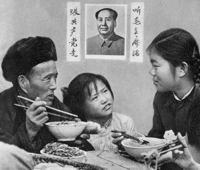
''We lost our links to the farmers. Our officials spent their time
dreaming about money and enjoying life. They forgot Chairman Mao's
advice that we should 'Eat, Live and Labor' with the peasants.''
LEI FENG'S BAUBLES
Even the myth of Lei Feng took a beating after his death in a
traffic accident in the liberalized 1980s.
In a dig at the hypocrisy behind the Spartan ideology Lei Feng was
purported to symbolize, a local newspaper reported at the time that
his personal effects included a leather jacket and an Omega watch.
Lei Feng's baubles were, of course, prime symbols of the ''bourgeois
liberalism'' and excessive consumerism that hard-liners have
attacked since the Tiananmen crackdown began.
The Lei Feng myth has since been exhumed minus any references to his
material possessions.
ON GUARD AGAINST DEMOCRACY
The party cadres, meanwhile, are on guard against any reappearance
of the pro-democracy movement and its ideological deviations.
''These are the things we must drive out of our society,'' said Feng
Zhi Qi, a party official in Wang Cheng County.
Changsha was the scene of marches and violent clashes in April 1989
that many observers feel marked the first steps toward the clash at
Tiananmen six weeks later.
But Feng insisted that ''no single farmer from this county took part
in a demonstration,'' and he called the incidents ''the work of a
few unhappy people.'' His assessment is sorely at odds with the
conclusions aired at the time on Chinese television and in local
newspapers.
As the party itself clearly understands, rewriting recent history
may be the least of the challenges it faces in the effort to
reassert control over the countryside.
GET CLOSE TO THE PEASANTS
The most striking symptom of its continuing anxieties was the
proclamation three months ago of ''Document Number Six,'' a party
directive ordering local officials to work at least one day a week
in the fields.
Document Six is designed to counter the pervasive impression that
party bureaucrats know very little about the lives of people their
decisions govern.
''The idea is that we are supposed to jump out of our official jeeps
and get close to the peasants again -- spread fertilizer, harvest
grain, you name it,'' said Liu De Rong, party secretary in Sichuan
province's Jin Feng Township.
Liu, a former rice-grower, had the weathered face and arms of a man
who did just that.
But if Feng Zhi Qi is taken as an example, Hunan party leaders are
further from the socialist goal than their Sichuan brethren.
Like most local cadres now in power, Feng rose to his post in the
past year, replacing predecessors deemed too untrustworthy -- often
because they were implicated in the 1989 demonstrations or openly
expressed sympathy for the dissident students.
A YEAR OF PURGES
More than 33,400 officials nationwide have been purged since June
1989 for what party newspapers describe as ''unhealthy tendencies.''
An additional 160,000 have been disciplined.
Feng's orthodox credentials cannot be faulted.
In conversations with peasants, factory workers and other officials
during a reporter's visit to Wang Cheng County, Feng answered every
question himself, rather than risk the chance of someone responding
with the ''wrong'' information.
But he exhibited little in the way of shared experience with the
proletariat.
A Californian who grew up on a Sonoma County farm and accompanied
the reporter to Hunan quickly noted that Feng's fashionably long
fingernails and soft hands ''couldn't stay that way after one day in
a rice paddy, much less one day per week.''
Notable, too, was the fact that Feng exchanged greetings with none
of the poorer farmers he passed on the way to an afternoon at the
home of a 10,000 yuan-per-year family, headed by a local party
member.
It was obvious that they had never seen him before.
© 1990 The Chronicle Publishing Co.
|