|
|
From Geremie R. Barmé,
Shades of Mao: The Posthumous Cult of the Great Leader
(Armonk, New York: M.E. Sharpe, 1996), pp. 19-21.
Reproduced with permission of the author.
There was something for everyone in the Mao persona. As Edgar
Snow wrote in the early 1960s: "What makes him [Mao]
formidable is that he is not just a party boss but by many
millions of Chinese is quite genuinely regarded as a teacher,
statesman, strategist, philosopher, poet laureate, national hero,
head of the family, and greatest liberator in history. He is to
them Confucius plus Lao-tzu plus Rousseau plus Marx plus
Buddha...." (73) In the 1990s, Mao remains a patriotic
leader, martial hero, philosopher-king, poet, calligrapher
(surrounded as he so often was with the bric-à-brac of the
traditional literatus --cloth-bound books, writing brushes and ink
stones), but he is also widely seen in a positive light as a
strong and irascible figure, a wily infighter, a man who was both
emperor and oracle, the ultimate Machiavellian manipulator who
knew, many would argue, just how to keep the restive Chinese
nation in place. (74) Mao consciously played on the contrasting
Chinese traditions relating to the Sage-Emperor and rebel
chieftain... . (75) As one academic has noted -- and it is a
remark that remains significant today -- the Communist revolution
(and we could add Mao as both an individual and symbol), had
"carried through [an]...attempt to reconstruct the world in
the spirit of inner-worldly transcendence inherent in
Confucianism." (76)
For many people Mao represented not only national but also
physical potency. Most of the Mao-related jokes current from the
early 1980s cheerfully reflected the leader's prowess in bed, and
they often used figures like Zhou Enlai or Hua Guofeng as foils.
On one level such humour represented a transgression against the
august figure of the Leader and allowed a popular invasion of the
"forbidden zone" (jinqu) relating to the person
of Mao. On another level, they were also indicative of a gradual
process that has seen Mao become more human, approachable and, in
the new Mao Cult, the familiar of the Chinese masses. Through this
process, one often described by Chinese critics as
"secularization" (shisuhua), Mao has been
enlisted in the ranks of the people in contrast and even
opposition to the present leaders who were increasingly perceived
of as being sectarian, corrupt and lacklustre. (77) The
fascination with the details of Mao's everyday life as given in
the plethora of books published from 1988 ... is also an
indication of this process. Despite the Chinese authorities'
denunciations of the BBC for broadcasting Dr. Li Zhisui's
revelations concerning Mao's sex life in early 1994, one could
speculate that popular opinion in China was probably neither
particularly outraged nor surprised by the latest proof of the
Chairman's talents. If anything people may well regard Mao's
voracious appetites as further evidence of his exceptional
stature, superhuman energy and unequivocal success.
It could also be argued that Mao, the ultimate father-mother
official (fumu guan), enjoyed such a broad appeal because,
to an extent, he was a love object ... . (78) One could argue that
he was also a bisexual or omnisexual figure. Mao's official
portrait shows the enigmatic face of a man-woman (or
grandfather-mother). In poetry, song and prose he had often been
eulogized as a mother/father, and his personality in all of its
majesty and pettiness fits in with complex attitudes regarding
sexual personæ. In his dotage Mao, a bloated colossus
supported by young female assistants, (79) often looked like a
grand matriarch, time having blurred his features into a fleshy
unisex mask. Li Zhisui's memoirs,
The Private Life of Chairman Mao, provide numerous
fascinating insights into the Chairman's various peccadilloes, not
least of which was his irrepressible and, in some cases, bisexual
appetite. Not only did he disport himself with a bevy of comely
ingenue, it would appear that he was not above lunging at the
handsome young men in his guard who put him to bed, or to expect a
"massage" from one of their number before retiring.
(80)
In this context it is instructive to recall the reaction of the
American journalist Agnes Smedley to her first meeting with Mao in
Yan'an:
His hands were as long and sensitive as a woman's.... Whatever
else he might be he was an aesthete. I was in fact repelled by the
feminine in him. An instinctive hostility sprang up inside me, and
I became so occupied with trying to master it, that I heard hardly
a word of what followed... (81)
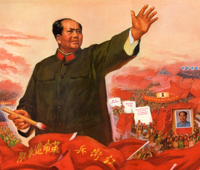
The Mao suit only added to the sexual egalitarianism of the Mao
image. While in his later years Mao was a wrinkled, green-toothed,
slack-jawed old man, the official description of the Chairman was of
a vibrant and healthy individual whose features remained unravaged
by that mighty sculptor time. His pictures were airbrushed to
perfection and his appearance in documentary footage carefully
doctored to present the best possible image so that even in terminal
decline official propaganda could claim that he "glowed with
health and vigour, and he enjoyed a ruddy complexion."
73. Quoted in Jerome Ch'en, ed., Mao, Englewood Cliffs,
N.J.: Prentice-Hall, 1969, p. 131.
74. One of the most evocative fictional depictions of Mao as
mastermind can be found in the Albanian novelist Ismail Kadare's
The Concert: A Novel, written in Albanian and translated
from the French of Jusuf Vrioni by Barbara Bray, New York: William
Morrow & Co., 1994, pp. 25-39, 79-90, 181, 311-312, 323.
75. Schram, "Party Leader or True Ruler?" p. 235 and n.
84.
76. See Shmuel Eisenstadt, "Innerweltliche Transzendenz und
die Strukturierung der Welt. Max Webers Studie über China und
die Gestalt der chinesischen Zivilisation," quoted in Schram,
"Part Leader or True Ruler?" p. 228. In this context,
see also Thomas A. Metzger,
Escape from Predicament. Neo-Confucianism and Chinese Evolving Political Culture, New York: Columbia University Press, 1977, pp.
121 & 233, also quoted in Schram, pp. 226 & 228.
77. As the government's campaign against corruption widened in
1995, many people seemed unimpressed by all the storm and fury.
One comment was: "All the Beijing officials are corrupt.
Chairman Mao wasn't a good man, but at least he knew how to deal
with corruption." Graham Hutchings, "China's Anger with
Leaders Bursts Out," The Telegraph, 14 April, 1995.
78. See Mayfair Mei-hui Yang,
Gifts, Favors, and Banquets. The Art of Social
Relationships in China, Ithaca & London: Cornell University
Press, 1994, pp. 257-258.
79. For the memoirs of the two most prominent of Mao's
"personal secretaries," or shenghuo mishu as they
were commonly referred to, see Zhang Yufeng,
Mao Zedong yishi, Changsha: Hunan renmin chubanshe, 1989;
and, Meng Jinyun's recollections as published in Guo Jinrong,
Mao Zedongde huanghun suiyue, Hong Kong: Tiandi tushu
youxian gongsi, 1990.
80. Zhisui Li,
The Private Life of Chairman Mao: The memoirs of Mao's
personal physician Dr. Zhisui Li, translated by Tai Hung-chao,
London: Chatto & Windus, 1994, pp. 358-359.
81. Quoted in Simon Leys, "Aspects of Mao Tse-tung
(1893-1976),"
Broken Images, New York: St. Martin's Press, 1980, p.
64.
|