
Reddest Red Sun
|
|
Reddest Red Sun |











|
The 'Red Family'
China Reconstructs, August 1969, p. 13 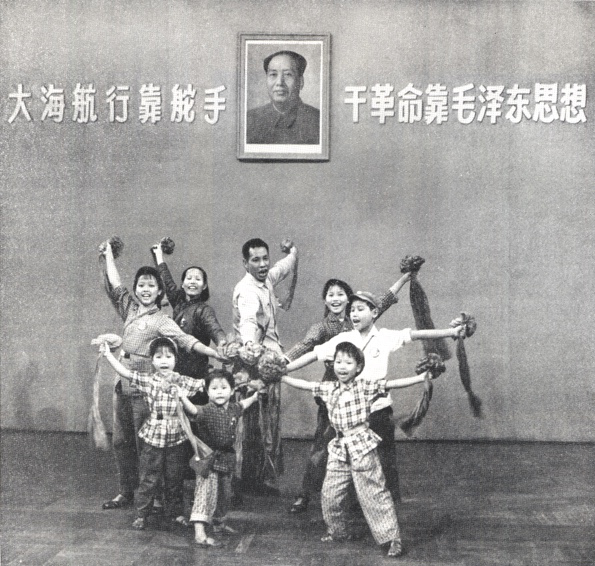 The "Red Family" Mao Tse-tung Thought propaganda team of
Lunghua production brigade, Polo county, Kwangtung province, consists
of the 40-year-old poor peasant couple, Ting Lai-yu and Chang Chiung,
and their six children from three to fourteen years. The family's
two-hour programmes containing dozens of revolutionary items attract
hundreds of people every time they perform. Known far and wide, the
family is praised by everybody. "The 'Red Family' propaganda team
has a style all its own and is well worthy of the name."
The "Red Family" Mao Tse-tung Thought propaganda team of
Lunghua production brigade, Polo county, Kwangtung province, consists
of the 40-year-old poor peasant couple, Ting Lai-yu and Chang Chiung,
and their six children from three to fourteen years. The family's
two-hour programmes containing dozens of revolutionary items attract
hundreds of people every time they perform. Known far and wide, the
family is praised by everybody. "The 'Red Family' propaganda team
has a style all its own and is well worthy of the name."
While none of the Tings has had more than six years' schooling, they have always been an outstanding collective in the living study and application of Mao Tsetung Thought. In the cultural revolution they have raised their loyalty to Chairman Mao to a new height, studying and applying Chairman Mao's recent instructions earnestly and propagating them widely. To do this more effectively, they worked hard with help from People's Liberation Army men and quickly learned some hundred revolutionary songs and prepared more than fifty song and dance items. Everyone in the family takes part in the performances. At every performance Ting Lai-yu recalls to the audience the bitterness of the past and compares it with today's happiness won under Chairman Mao's leadership - a vivid class education. He also describes how his family studies Chairman Mao's teachings and applies them in daily practice. Their items praising Chairman Mao and propagating his latest instructions make an indelible impression on audiences. Beloved Chairman Mao, the red sun shining in our hearts; How many words so deep in our hearts we long to say to you … This song is not just a performance, it is an expression of the loyalty and deep feeling that all of China's 500 million peasants have for their beloved Chairman Mao. Now the song and dance "Never Forget Class Suffering; Be Revolutionaries Forever" composed by the family. The lights dim. Five-year-old Hung-lien, in rags, comes on stage. Wiping away tears of grief and clenching her fists angrily, the little girl exposes the evil old society while the rest of the family sings an accompaniment. "Recalling the old society brings tears to our eyes. Three big mountains* weighed us down. Our family of eight was torn apart. Nowhere could we speak of our bitterness and pour out our grievances…" This typical representation of the bitter class oppression suffered by millions upon millions of labouring people in old China takes the audience back to the dark old days and never fails to move them deeply. Shouts ring out, "Never forget class suffering, always remember blood-and-tears hatred!" "Never forget class struggle!" "A clap of spring thunder rolls across the sky. Our saving star, the Chinese Communist Party, leads us in revolution. We rise to our feet and win liberation…" Beating of drums and gongs. Two girls in red come onto the brightly lit stage. Waving long red silk scarves, they sing and dance to celebrate liberation. The joyous atmosphere and songs depicting the happiness of the new society contrast sharply with the dark old days of the previous scene. The performance is in fact a re-enactment of the story of the Ting family. This story, familiar to so many, and the realistic atmosphere on the stage move the audience to a deeper understanding of Chairman Mao's teaching, "Never forget class struggle". "Never forget class suffering; be revolutionaries forever!" This firm pledge of the poor and lower -middle peasants is the class and ideological basis for the Tings becoming a "red family". Before liberation Ting Lai-yu was one of a family of eight. But ground down by poverty and illness under the brutal rule of the Kuomintang reactionaries, his mother and father died when he was fourteen, leaving six boys who either died of hunger or had to flee from famine. Lai-yu himself had to beg for a living and wandered about until he came to Polo county where a peasant family adopted him. His wife, Chang Chiung, sold three times before she was twelve, finished up as a bondservant in a landlord's house. Both had their fill of bitterness in those days. In the happy new society, Ting Lai-yu and Chang Chiung married and established their own home. Ting had the honour of joining the Communist Party and became a brigade cadre. After some time, there were again eight in his family. The number was the same, but how different the life in the two societies! Thinking back on the past, looking at the happy life today and to the future, Ting Lai-yu and his wife, their eyes filled with tears of gratitude, always say to others, "We owe it all to Chairman Mao." Chang Chiung bought a big portrait of Chairman Mao with her savings and put it on the wall so that the whole family could see the great leader who was always in their thoughts. Ting put up a couplet: Forever loyal to Chairman Mao, Our hearts will not change even if the sea dries up and the stones rot. They often stand with their children before the portrait and pledge: "Having won liberation, we will always remember the Communist Party; living in happiness, we will never forget Chairman Mao. We wish Chairman Mao a long, long life!" Here is an example of Ting Lai-yu educating his children: Someone once asked Hung-lien, "Who gave you that new dress?" "Father bought the cloth and Mother made the dress." The girl's reply disturbed her father. At the family's study meeting, he told the children, "Your mother gave you birth. But it is the Party that educated you, it is Mao Tsetung Thought that nurtures your growth. The rice you eat, the clothes you wear, you owe them all to our Party and Chairman Mao, not to your mother and father. In the old society I also had a mother and father. But I had no food to eat and no clothes to wear. Year in and year out I went hungry and cold. We never had a happy life like yours. You must never forget our bitter past!" Having grown up in poverty, Ting and his wife know well the meaning of "class" and "exploitation" and hate Liu Shao-chi's evil ambition to restore capitalism. When Chairman Mao called on the people to "Fight self, repudiate revisionism", they immediately started a Mao Tsetung Thought study class to put this important instruction into practice. They held meetings and, using their personal experience, repudiated Liu Shao-chi's vicious ideas that "class struggle has died out" and "exploitation has its merits". They told about their childhood suffering and compared it with today's happy life, giving the children a profound class education and turning the family into a classroom for the living study and application of Mao Tsetung Thought. From this time the family began performing revolutionary songs and dances as recreation activities. Their experience shows that such activities promote the ideo-logical revolutionization of the family. One day, as Hung-lien and her mother were going to a meeting, somebody called, "Hung-lien, will you sing me a song?" The girl turned round and saw the landlord's wife. She gave the woman a scornful look and walked on. Not knowing who had spoken, the mother asked, "Why don't you sing her a song since it is to propagate Mao Tsetung Thought?" The girl didn't answer, but when they got back home, she criticized her mother. "Mama, you told me to sing for the landlord's wife. You've forgotten 'Who are our enemies?' How could I sing for her?" Pleased to find her daughter taking such a clear class stand, Chang Chiung readily accepted the criticism. In family education, the parents set a good example with their own conduct. They take the lead in making a living study and application of Chairman Mao's works, in fighting selfishness and fostering devotion to the public interest. The family is determined to place Mao Tsetung Thought in command of everything. "Of hundreds of thousands of books, the most important are Chairman Mao's works. Of hundreds of thousands of roads, the one we take is the revolutionary road pointed out by Chairman Mao." In spite of his difficulty in reading, Ting Lai-yu studies Chairman Mao's works every day and puts into practice what he has learned. Once in a flash flood, the river dyke near their home was in danger of collapsing. If the water burst through, the ripening millet would be ruined. Ting Lai-yu was down with a high fever. Chang Chiung, concerned for her husband's health, told him to stay in bed. "No," he said, "Chairman Mao teaches us to have an indomitable spirit. How can I lie in bed with a slight illness when the commune's millet is about to be washed away?" He got up and joined the other commune members in their battle to save the dyke, persisting till victory. A good example inspires great strength. This devotion to the public interest made a deep impression on his children. In recent months, carrying simple props and holding high a red flag, the Tings have climbed mountains and waded streams to propagate Mao Tsetung Thought. They have given more than 300 performances for audiences totalling 400,000 in factories, communes, army units, schools and government organizations. Their revolutionary action has the support of revolutionary committees everywhere and earned them the name "Red Family" from the workers, peasants and soldiers. *The phrase "three big mountains" refers to imperialism, feudalism and bureaucrat-capitalism. See also "The Whole Family is Red," from China Pictorial |
About the Site |
Living Revolution |
Smash the Old World! |
Reddest Red Sun |
Stages of History |
The East is Red
The Film | Multimedia |
Images | Library |
Site Map
Home
© Long Bow Group, Inc. All Rights Reserved.