|
|
MaoSpeak by Wang Shuo
Introduction by Geremie Barmé
Many selections in this volume [Shades of Mao] reek of
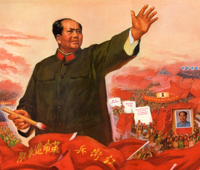
MaoSpeak, or NewChina NewSpeak (Xinhua wenti), popularised on
Mainland China as the political and social lingua franca from
the 1940s. The Beijing novelist Wang Shuo utilized this
language from the late 1980s in his satirical studies of life
under socialism in its terminal phase.1
In the works of Wang Shuo the play on Maoist language was part
of a sincere at the same time as ironic revival of Mao and, in
the early 1990s, Wang's work created a fad of its own which
encouraged a tongue-in-cheek recycling of Party language in
the Chinese media, in particular TV. MaoSpeak did indeed
repeat itself, first as tragedy then as farce.
Wang's nostalgia for the Cultural Revolution is real and
vital. For him and many of his generation what was officially
dubbed the "ten years of chaos" (shinian dongluan) had offered
opportunities for sexual liberation, playing truant and the
joys of gang warfare.2 In 1990s' China, with the help of
Deng's Reform policies, Wang and his fellows helped turn the
rowdy youth culture of the Cultural Revolution into a
pseudo-ethos of the Reform Age. Many of them also made a lot
of money out of China's further social and cultural
degradation. The anti-intellectualism evident in much of
Wang's work--he consistently lambasts Chinese
intellectuals--has also antagonized some readers who see in it
a disturbing streak of chip-on-the-shoulder Maoist
hooliganism. He has defended himself by quoting Mao Zedong:
"The lowly are the most intelligent; the elite are quite
ignorant", and he claims that only by overthrowing the
intellectuals can people like him enjoy true freedom
(fanshen).3Although one may appreciate Wang's dim view of
intellectuals, to use satire, a weapon traditionally best
employed against the powerful, to consistently denegrate the
weak and powerless is not so much funny as vulgar.
Wang Shuo's novel
Don't Treat Me As a Human Being (Qianwan bie ba wo
dangren), or No Man's Land, was serialized in 1989 and
reprinted in 1991 and 1992. It is Wang's satirical
masterpiece, a loving and scarifying look at the dark side of
the Chinese national character.4 In a 'letter of appreciation'
(ganxiexin) to the Party leadership read out by the grateful
denizens of Tanzi Alley at the end of the novel, Wang Shuo
creates an extreme parody of the logorrhea of Chinese
political and commercial language, with some gratuitous
references to traditional Chinese snake-oil remedies thrown in
for good measure. The letter is read out as a tearful
incantation by the mother of Tang Yuanbao, the novel's
picaresque hero.
"Praise be to you, Lord Clear Sky! We the inhabitants of Tanzi
Alley thank you for rescuing us from the bitter sea, from the
flaming pit, from hell itself."
Tang Yuanbao, at the head of the inhabitants of Tanzi Alley, led
everyone as they knelt down in the dirt in supplication. [The
Party leader] Fatty approached on a horse, dismounted, helped
the old lady [Tang's mother] to her feet and called out to the
others:
"What is all this? Come on all of you, up on your feet. This
really is too much. After all, I'm one of you, your servant. All
I've done is make some decisions on your behalf and give you my
support. You don't have to thank me."
At this point, Yuanbao's mother began mumbling. Crying and
chanting she praised Fatty:
"You have righted the wrong and crushed the bad in one fell
swoop. Respected wise dear teacher leader helmsman pathfinder
vanguard pioneer designer bright light torch devil-deflecting
mirror dog-beating stick dad mum grandad grandma old ancestor
primal ape Supreme Deity Jade Emperor Guanyin Bodhisattva
commander-in-chief:
"You who are busy with: ten thousand weighty matters each day,
long-suffering one bad habits die hard and overworked to the
point of illness done too often can be habit-forming shouldering
heavy responsibilites speeding through the skies powerful and
unconstrained staving off disaster and helping the poor
dispelling the evil and ousting the heterodox, you who eliminate
rheumatism cold sweats strengthen the yang and invigorate the
spleen the brain who are good for the liver stomach pain
relieving and cough repressing, and able to cure constipation.
"You personally yourself in propria persona have come deigned
lowered yourself honoured us with your presence to investigate
look over police search patrol pay a visit to ask about express
solicitude and come to our alley. For our alley this is the most
magnanimous expression of concern a massive encouragement a
great impetus a considerable relief formidable expression of
trust and care a great honour and really a nice thing to do. We
are little people knaves the black haired scum your children
grandchildren tufts of grass little dogs and cats a gang of
liumang [hooligans] the cretinous crowds the great masses the
hundred surnames and we feel ohsolucky extremely moved
exceedingly uneasy terribly embarrassed so very pleased
boundingly enthusiastic very very overwhelmed by our good
fortune grateful as all get out tears o'fill our eyes our hearts
swell like the seas and we're utterly and thoroughly lost for
words. Ten thousand words a million songs endless mountains and
seas ceaseless groans and grumbles mumbles and whispers
expressions and phrases all combine into one sentiment which
rends the very heavens an hysterical sound cracking through the
universe circling the rafters for three days deafening
reverberating through heaven and earth moving all who hear it
mysterious and beautiful beyond compare making people drunk
pissed completely out of it so they don't know the taste of meat
for three days for it is the overriding chord of the age:
longlife longlife longlonglife longlife longlife longlonglife!
Yuanbao's mother fainted dead away and Mother Li stood up to
take her place, continuing in rapid fire:
"Without you we would still be lost in the darkness dimness
greyness dustiness sootiness ashiness in a ditch a hole in the
ground a cave a ravine a gully an abyss in a wok of boiling
water in a firepit a vat of boiling oil in the bitter waters and
we would be splashing gnashing crashing flashing flipping
kicking..."
She too went into a swoon and Yuanfeng took over:
"You are the light hope future ideal banner clarion wardrum
victory success pride dignity triumph heaven Buddhaland wiseone
shaman genius magician tuletary diety saviour sun moon stars
effulgence splendour light ray beam brilliance... ..."
She gave up the ghost and her place is taken by Blackie:
"Hercules hawk falcon lion tiger bronze-headed golden-faced
steel-legged iron-armed lightning-fisted cannon guided missile
mainstay tombstone great wall mountain pass. Without you we
would freeze to death starve to death be beaten berated argued
to death die for being disorderly burn and drown to death die of
hanging from falling and being treated really badly by others..
..."
"Enough already," Fatty said with a benevolent smile. "If you go
on you'll just keel over and faint too. In the past, I've heard
my fill of respectful praiseful laudatory admiring speeches. You
could go on until everyone in this alley died from exhaustion
and you still wouldn't run out of things to say. It doesn't do a
thing for me. I don't want you to run yourselves down like this.
If you really want to make me happy then learn how to take care
of yourselves. That's the best present you could give me."
"But you have to take us in hand, no matter what," Blackie said
tearfully. "We can't survive without you. You are the clear
skies, we are but tufts of grass. Without the sky how could the
earth exist? Grass needs to be tended, watered, weeded and cut.
We can't do it ourselves. Anyway, we're used to being kept in
place. If you make us take over and leave us without anyone to
cuss us kick us hit us and push us around we won't be able to
eat drink sleep or shit. We'll lose control completely."
"No matter what, you can't leave us like this," the residents of
Tanzi Alley chorused as they knelt. "We're happy to let you ride
beat berate whip us. If it makes you happy order us around drive
us and trample us under foot. If you're displeased feel free to
punish humiliate and generally take it out on us. If anyone
dares utter the slightest objection you won't have to lift a
finger because we'll take care of them ourselves. Do what you
will with us, but whatever you do don't say you're going to
leave."
"Come on, get up," Fatty said with a heavy sigh. "How could I
possibly leave you to your own devices?"
Notes
1. For a single-volume collection of these stories, see Wang
Shuo wenji (4): xiexue juan, Beijing: Huayi chubanshe, 1992.
2. See the depiction of this world in Wang's 1991 story "Dongwu
xiongmeng", reprinted in Wang Shuo wenji (1): chunqing juan,
Beijing: Huayi chubanshe, 1992, pp. 406-493; and, Jiang Wen's
1994 screen version of the story, Yangguang canlande rizi.
3. See Wu Jiafeng, "Ping Wang Shuode yiduan hua", Ershiyi shiji,
1993: 12, p. 144. During a tour of inspection of Dandong,
Liaoning Province in 1958, Mao visited a tractor factory and
wrote an inscription (tici) for the workers which read: "The
lowly are the most intelligent; the elite are the most ignorant"
(beijianzhe zui congming, gaoguizhe zui yuchun). Since the
inscription was penned on 18 May (5 yue 18 ri), the factory
changed its name to Factory No. 518. See also Ying Da, "Wang
Shuode yuyan" in Liang Huan, ed., Mingren yanzhongde Wang Shuo,
Beijing: Huayi chubanshe, 1993, pp. 116-120.
4. For further details of this story, see Barmé, "Wang Shuo and
liumang ('hoooligan') culture", The Australian Journal of
Chinese Affairs, no. 28, July 1992, pp. 51-60.
|