|
|
Red Guards Destroy the Old and Establish the New
Peking Review, No. 36 (9/2/1966), p. 17
Since August 20, the young Red Guards of Peking, detachments of
students, have taken to the streets. With the revolutionary rebel
spirit of the proletariat, they have launched a furious offensive to
sweep away reactionary, decadent bourgeois and feudal influences,
and all old ideas, culture, customs and habits. This mounting
revolutionary storm is sweeping the cities of the entire nation.
"Let Mao Tse-tung's thought occupy all positions; use it to
transform the mental outlook of the whole of society; sweep away all
ghosts and monsters; brush aside all stumbling-blocks and resolutely
carry the great proletarian cultural revolution through to the
end!" This is the militant aim of the young revolutionary
fighters. Their revolutionary actions have everywhere received the
enthusiastic support of the revolutionary masses.
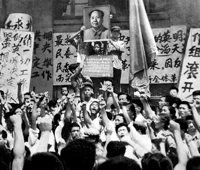
In Peking. During the past week and more Red Guards
have scored victory after victory as they pressed home their attack
against the decadent customs and habits of the exploiting classes.
Beating drums and singing revolutionary songs detachments of Red
Guards are out in the streets doing propaganda work, holding aloft
big portraits of Chairman Mao, extracts from Chairman Mao's works,
and great banners with the words: We are the critics of the old
world; we are the builders of the new world. They have held street
meetings, put up big-character posters and distributed leaflets in
their attack against all the old ideas and habits of the exploiting
classes. As a result of the proposals of the Red Guards and with the
support of the revolutionary masses, shop signs which spread odious
feudal and bourgeois ideas have been removed, and the names of many
streets, lanes, parks, buildings and schools tainted with feudalism,
capitalism or revisionism or which had no revolutionary significance
have been replaced by revolutionary names. The service trades have
thrown out obsolete rules and regulations.
Support for the revolutionary actions of the Red Guards has been
expressed in countless big-character posters which the masses of
revolutionary workers and staff have put up in the newly renamed
major thoroughfares of the capital. They have also expressed their
support with street demonstrations.
Draping the many-storied front of the newly renamed Peking
Department Store are gigantic banners with the words: "Resolute
support for the revolutionary students' revolutionary actions!"
and "Salute to the young revolutionary fighters!" Workers
of the Peking Steel Plant, encouraged by the actions of the
revolutionary students, have launched vigorous attacks on old ideas,
styles of work, methods and systems that hamper the revolution and
production in their plant. They have put forward many revolutionary
proposals and already begun reforms. Workers at the Peking No. 2
Cotton Textile Mill are emulating the revolutionary rebel spirit of
the Red Guards and are attacking all old influences. The workers
hold that everyone has the right to sweep away the influences of the
old, not only outside, in the streets, but also in the factories and
all other enterprises and in government offices. In this way, by
sweeping together, the great proletarian cultural revolution will be
carried through to complete victory.
Commanders and fighters of the People's Liberation Army in the
capital have unanimously expressed support for the revolutionary
students' revolutionary actions, and the carrying of the great
proletarian cultural revolution through to the end. They say that
the great revolutionary actions of the revolutionary students in
attacking bourgeois ideology, customs and habits is another instance
of the great material strength that is generated by Mao Tsetung's
thought once it grips the revolutionary masses. Speaking at a
discussion meeting of the 12th company of a garrison unit in Peking
commanders and fighters said that the revolutionary actions of the
young fighters are smashing the old world and buirding a new world.
Pao Hsi-ming, of a P.L.A. Navy Air Force unit who won a combat
citation, second class, for shooting down a U.S. made plane of the
Chiang gang, told a Hsinhua correspondent that the revolutionary
actions of the Red Guards were thoroughgoing revolutionary actions
as the result of their following the teachings of Chairman Mao and
acting according to his instructions. "They are doing right and
doing fine," he said.
In Shanghai. In this huge city which has the
largest concentration of capitalists in the country and which, until
the liberation, had long been under the rule of the imperialists and
domestic reactionaries, the.revolutionary students and the broad
masses of workers and staff have taken up their iron brooms to sweep
away all old habits and customs. The show windows of the Wing On
Co., one of the biggest department stores in the city, are plastered
with big-character posters put up by the Red Guards and workers and
staff of the store, proposing that "Wing On" (Eternal
Peace) should be changed into "Yong Hong" (Red For Ever)
or "Yong Dou" (Struggle For Ever). The posters point out
that in the old society the boss of the store chose the name
"Wing On" because he wanted to be left in peace for ever
to exploit the working people. "For a long time now the store
has been in the hands of the people and we are certainly not going
to tolerate this odious name a day longer," say the posters.
In "The Great World," the biggest amusement centre of
Shanghai, workers and staff together with the Red Guards took down
the old name sign which was several metres long. When the last
character of the sign was brought down, thousands of revolutionary
people in the streets and in the windows of neighbouring buildings
applauded and cheered: "Long live Chairman Mao!" and
"Long live the great proletarian cultural revolution!"
The waterfront of the Whangpoo River in Shanghai was, until the
liberation, the centre of imperialist plunder of the Chinese people.
The buildings here have still carried many reminders of the
imperialists and here the Red Guards and revolutionary workers and
staff have gone in for revolutionizing in a big way. They have taken
down all the imperialist signs from walls and removed the bronze
lions outside one of the big buildings.
The revolutionary workers and staff of Shanghai barber shops have
adopted revolutionary measures in response to the proposals of the
Red Guards: they no longer cut and set hair in the grotesque
fashions indulged in by a small minority of people; they cut out
those services specially worked out for the bourgeoisie such as
manicuring, beauty treatments and so on. In those shops which sold
only goods catering to the needs of a small minority of people,
workers and staff have taken the revolutionary decision to start
supplying the people at large with good popular commodities at low
prices.
In Tientsin. For the past several days there has
been a new revolutionary atmosphere in the streets. Drums and gongs
have been sounding around Binjiang Street, the business centre, and
firecrackers have crackled all day long; many shops have discarded
their old shop signs, and replaced them with new revolutionary ones.
Inspired by the revolutionary spirit of the Red Guards, the
revolutionary workers and staff members of "Quanyechang,"
one of the biggest markets in the city, smashed the name sign inlaid
in its wall for the past 38 years and hung up a new sign, the
"People's Market." The "Beiyang Textile Mill"
which was established in the time of the Northern warlords 45 years
ago is now renamed "Four-New Textile Mill," meaning a mill
with new ideas, new culture, new customs and new habits. The
"Golden Tripod," the factory's old trademark, has been
changed for a new trademark, "Worker and Peasant."
Hangchow. The Tungpo Theatre, Tungpo Road, and the
Su Ti (Su Dike) on Hangehow's West Lake named after Su Tung-po, a
feudal man of letters of eight centuries ago, have been given new
names with revolutionary meanings. The scissors shops which used the
former shop owner's name-Chang Hsiao-chuan- as their shop sign for
the past three centuries, have now taken the new name:
"Hangchow Scissors Shop."
In Sining. In the capital of Chinghai Province,
western China, the broad masses of revolutionary workers and staff,
revolutionary cadres and poor and lower-middle peasants are giving
resolute support to the young revolutionary fighters for their
revolutionary rebel spirit of defying heaven or earth. Some shops,
cinemas and theatres have been given new revolutionary names.
Carrying large portraits of Chairman Mao and beating drums and
gongs, the workers of the Sining Transport Vehicle Plant, a model
enterprise, paraded the streets, pledging their support to the young
fighters. Backing up the young revolutionary fighters, the poor and
lower middle peasants of the Mafang People's Commune have changed
their commune's name into the "Workers, Peasants and Soldiers
Commune."
In Lhasa. This city's streets have been bubbling
with excitement throughout the past few days. Carrying big portraits
of Chairman Mao, displaying declarations of war on the old world,
and beating drums and gongs, hundreds of Red Guards and
revolutionary students and teachers of the Tibetan Normal School and
the Lhasa Middle School took to the streets in a vigorous offensive
to destroy the "four olds" -old ideas, old culture, old
customs and old habits. In their declaration, the Red Guards and
revolutionary students and teachers of Lhasa Middle School
proclaimed: A decade and more has rolled by since Lhasa was
liberated. It was the great Communist Party of China and our great
leader Chairman Mao who led us in winning our emancipation and thus
we were brought to a happy life. However, the spiritual shackles put
upon us by the three kinds of serf-owners were still tight around
our necks. This can no longer be tolerated. It is high time for us
to settle accounts with them.
Red Guards and revolutionary students and teachers in Lhasa have
proposed to change the names of places, streets and houses which are
tainted with feudal serfdom and superstition. They also propose that
literary and art groups forbid the performance of operas and plays
which reek of imperialism and feudalism. The broad masses of workers
and peasants in Lhasa have unanimously pledged themselves to give
strong backing to the young Red Guard fighters and battle shoulder
to shoulder with them to transform the city of Lhasa into a new,
highly proletarianized and revolutionized city.
|