
The Gate of Heavenly Peace
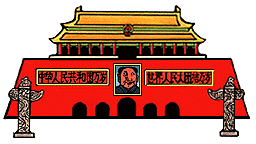
From the rostrum of Tiananmen Gate, the
Gate of Heavenly Peace, Chairman Mao declared the founding of the People's
Republic on 1 October 1949. By staging the founding day ceremonies here,
on one of a series of entrances into the Imperial City, the Communists
were declaring an end to the old order.
The open area in front of Tiananmen Gate was where ministers and subjects had
previously gathered to hear the proclamation of imperial edicts. In the 1950s,
the Chinese government ordered the building of a great square, large enough for
a million people to gather en masse. Tiananmen Square became a gigantic official
space - nearly one hundred acres - in which the public could be enlisted and
contained for political purposes.
Tiananmen Gate was reconstructed and reinforced with concrete, and from it Mao
and other Party leaders watched parades, the Cultural Revolution, and other events.
For a time Mao considered leveling the Imperial Palace that stands behind Tiananmen
to build a Chairman's office. The Gate is now flanked by reviewing stands built
for dignitaries invited to witness official, self-congratulatory Party parades
and demonstrations.
Tiananmen Gate was the focal point for the 35th Anniversary celebrations of the
People's Republic of China in 1984, the apotheosis of Deng Xiaoping's career,
and the centerpiece of the celebrations of the 40th Anniversary of the People's
Republic in 1989. The Gate is also the central feature of the national insignia
of the People's Republic of China.
Readings
The Gate and the
Square, an essay by Jonathan Spence
|