|
|
Shortly after midnight on September 9, 1976, Mao died at the age of
eighty-two. There was a ten-day period of national mourning. All
loudspeakers and radio stations broadcast somber music. Newspapers,
bordered in black, carried the obituary issued by the Central
Committee depicting Mao as "the greatest Marxist of the contemporary
era," and declaring that "the radiance of Mao Zedong Thought will
forever illuminate the road of advance of the Chinese people." At
three p.m., on September 18, all the people of China were ordered to
stop their work and stand in silence for three minutes. A million
people filled Tiananmen Square and all trains, ships, factories, and
mines throughout the country were ordered to sound their whistles
and sirens in salute.
All this chanting of ‘Long Life!’ is in contravention
of natural laws. Sooner or later, people die. They might be
invaded by germs, or crushed by a collapsing building, or blown to
pieces by an atom bomb. One way or another they end up dying. Once
you're dead you shouldn't occupy any space. Burn the bodies. I'll
take the lead. We should all be cremated when we die. Be turned
into ashes and used to fertilize the fields.
--Mao Zedong, in comments made when signing
"A Proposal for Central Leaders to Support Posthumous Cremation"
in 1956
Mao Zedong, the founding leader of the People's Republic of China,
its
gaozu as first emperors in China were traditionally called,
is now the only permanent resident of the Square. Following his
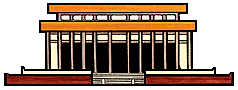
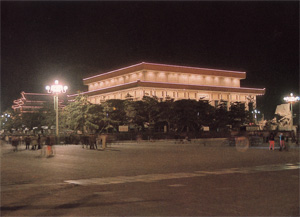
death, Mao's corpse was preserved for posterity. The mausoleum is
more than a tomb, it's a grand villa. There is a white marble
armchair inside as you enter with a massive statue of Mao seated on
it in imitation of Abe Lincoln. Behind this statue a massive mural
features the mountains and rivers of China, the geopolitical realm
of Mao's posthumous rule. In the crypt one can find Mao's body lying
in state on a bed covered in a crystalline sarcophagus and
surrounded by flowers. Like so many others in Beijing these days,
Chairman Mao goes to work everyday travelling from the nether world
by elevator to be on display for tourist and faithful alike. At
night his body retires after the last visitors have left to lie in
an earthquake-proof chamber deep in the bowels of Tiananmen Square.
Side halls in the Mausoleum contain relics of other "first
generation revolutionary leaders" -- Liu Shaoqi, Zhu De and Zhou
Enlai -- making this monument a true Ancestral Hall of the
Revolution.
Any investigation of this modern site would take the pilgrim to
other comparable traditional ancestral halls in the Chinese capital
like the Tai Miao, or Ancestral Temple, used for the worship of
deceased emperors standing next to Tiananmen Gate and renamed the
Workers' Cultural Palace (the Cultural Palace itself has often been
used by the Communist rulers to display the remains of government
rulers during state funerals). Then there is the Confucian Temple in
the north-east of the old city or the Daoist Dagaodian on the
north-west corner of the Imperial Palace which also once brimmed
with cultural significance and now are sequestered in the cement
highrise of new Beijing.
View a
video clip
of the mausoleum.
For more readings, see "MaoBody," by Geremie R. Barmé in
Shades of Mao: The Posthumous Cult of the Great Leader, and a
sketch by Yau Ma Tei, a satirist born in Peking in 1929, called "Maosoleum." See also "Tiananmen Square: A Political History of Monuments,"
Wu Hung (Representations 35, Summer 1991).
|