
Visit a School (Work-in-Progress)
Available Readings:
Quotations on Education
from Chairman Mao
Spring Thunder
in the Proletarian Educational Revolution, China Pictorial,
1968
Bringing Up the Younger
Generation, China Pictorial, 1966
| Classes,
Rituals and Routines:
Take an English Lesson. Other elements: morning exercises, daily
classes, content of textbooks, curricula. Feature film "Blossoms
of the Motherland."
Other topics to be explored include:
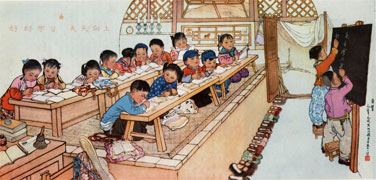
Space: What does a typical school look like?
What is the layout of a classroom? What can you read on the walls
(billboards, "blackboard newspapers," portraits of Mao,
Lenin, Marx, various kinds of honors)? What do you hear from the
loudspeakers? |
|
Relics: The school uniform; grade reports; flags;
the Red Guard armband; award certificates; class pictures; "blackboard
newspapers."
Militarization and Education. Hierarchy and "democracy"
- required military training and regimentation, the emphasis on discipline,
the military division into brigades, teams, etc. Changes during the CR.
Young Pioneers - Origins, induction rituals (the
red scarf, its meaning, and the various occasions for its use, the flag-raising
ceremonies, songs), handbooks on how to be a good young pioneer.
Themes:
Literacy - literacy (anti-illiteracy) campaign in the
early 50s, which was for the most part directed at adults but also sought
to build more schools for children.
"17 years of revisionist education" vs. Revolutionary
education, with 1966 as the dividing line. Theory and practice - ivory
tower and re-education by poor and middle-peasants. Feature film on
this topic: "Breaking with Old Ideas"
Aspirations and worldviews: e.g. what would a child
in the 50s want to be when they grow up? in the 60s? in the 80s? What's
the standard response: Scientist? Soldier? Farmer? Worker? Businessman?
How does a child draw the map of the world? What is "us" and what is
"other"?
Remembering Bitterness
Icons
Lei Feng
(Serve the people, self-sacrifice)
Zhang Tiesheng (the blank examination hero)
|