|
|
The Long March Detachment of Red Guards
Walks 1,000 Kilometres to Peking to Exchange Revolutionary Experience
China Reconstructs, 10/28/1966
Emulating the revolutionary spirit of the Chinese Red Army's Long
March, 15 revolutionary students of the Talien Mercantile Marine
Institute walked through 21 counties and cities in a month.
Following Chairman Mao's teachings that the Long March "is a
manifesto, a propaganda force, a seeding -machine," they
simultaneously studied Chairman Mao's works, spread Mao Tse-tung's
thought and learnt from the worker and peasant masses throughout
their journey.' They strictly observed the Three Main Rules of
Discipline and the Eight Points for Attention of the People's
Liberation Army. The masses living along their route praised them as
Chairman Mao's faithful young red soldiers.Under the brilliance of
Mao Tse-tung's thought, 15 revolutionary students of the Talien
Mercantile Marine Institute organized the Long March Detachment of
Guards. With boundless love for the great leader Chairman Mao and
emulating the revolutionary spirit of the Red Army's Long March, and
with staunch revolutionary determination to cross mountains and
rivers and overcoming many difficulties, they walked more than1,000
kilometres in a month from Talien in the northeast to the centre of
the great proletarian cultural revolution and the sacred centre of
world revolution - Peking, capital of our great motherland. This was
done for the purpose of exchanging revolutionary experience.
Carrying the red flag bearing the name, "Long March Red Guard
Detachment," these young fighters all had copies of Chairman
Mao's works in their knapsacks. They studied Chairman Mao's works
and spread Mao Tse-tung's thought all along the way. In accordance
with Chairman Mao's teachings, they carried forward the
"three-eight" working style of the Liberation Army and
learnt from the worker and peasant masses wherever they went. No
matter where they stayed, they helped the masses carry water and
sweep the courtyards and took part in productive labour. With the
Liberation Army as their example, they strictly observed the Three
Main Rules of Discipline and the Eight Points for Attention. The
workers and peasants living along the route they travelled warmly
praised them as "Chairman Mao's faithful young red
soldiers," "red descendants of the old Red Army and the
old Eighth Route Army," and "a propaganda force of Mao
Tse-tung's thought."
In August when the revolutionary teachers and students all over the
country, under the guidance of the great red banner of Mao
Tse-tung's thought, were exchanging revolutionary experience on a
big scale, Li Lung-fu and other Talien Mercantile Marine Institute
students had the chance to be the first group to go to Peking by
train for the same purpose. And they longed to fly immediately to
Chairman Mao's side!
However, they did not leave immediately because they were
considering how to make this unforgettable act in their lives more
meaningful. Some of them had seen the picture of the great leader
Chairman Mao in army uniform when he had received a million
revolutionary masses on August 18, and they recalled scenes of the
Red Army's 12,500-kilometre Long March which crossed many mountains
and rivers. To win a complete victory in the great proletarian
cultural revolution, they thought to themselves, it was necessary to
have both dauntless revolutionary spirit and steel-like
revolutionary will and energy. In this great revolution which
touches the souls of the people, it was necessary to emulate and
carry forward the Long March spirit of the old Red Army and to
temper and cultivate the Liberation Army's working style of enduring
extraordinary hardships. They made a bold proposal: Go to Peking on
foot!
"To Them a Thousand Mountains, Ten Thousand Rivers Are
Nothing"
The 15 young revolutionaries set out with a heroic spirit on the
morning of August 25. Fearing neither wind nor rain and taking
neither vehicles nor boats, they walked over mountains, swam across
rivers, and travelled through 21 counties and cities and one
reclamation region in Liaoning and Hopei Provinces. They faced the
world and braved the storms as they marched over the vast land, they
passed a severe test of their revolutionary will.
Inspired by the great thought of Mao Tse-tung and brimming with
lofty revolutionary aspiration, they trampled down one difficulty
after another along the road. When they encountered gales and
downpours on their journey, they recited together Chairman Mao's
poem: "The Red Army fears not the trials of a distant march; To
them a thousand mountains, ten thousand rivers are nothing…
." In marching against wind and rain, they also loudly sang We
Love Chairman Mao Most and other revolutionary songs. When big
rivers cut across their route, they encouraged each other with the
great example of Chairman Mao swimming in the Yangtse and his
majestic poem "I care not that the wind blows and the waves
beat; It is better than idly strolling in a courtyard." They
swam across the rivers and said: "Chairman Mao swims in the
Yangtse even at the age of 73. We are New China's future seamen who
should all the more be tested in great storms.
When their feet were swollen and blistered and they felt very tired,
they read the passage from Chairman Mao's works "Be resolute,
fear no sacrifice and surmount every difficulty to win
victory." They then immediately became full of spirit and their
courage increased a hundredfold. Mao Tse-tung's thought is strength!
Wind, rain or pain meant nothing to these youngsters! Learning from
the practice of the old Eighth Route Army, they broke their blisters
with hair, plastered their ankles and continued their march with big
strides, chin up and chest out. One after another, motor vehicles
and carts caught up with them and passed them. Many drivers warmly
invited them to ride with them, but they politely declined.
When they could not sleep at night because of mosquitoes and insects
in their lodging places, they thought about the trials endured by
their revolutionary predecessors. They said: "Our present
conditions are so many times better than those of the Red Army in
the past, why should we complain?"
Red Propaganda Force
The fighters of the Long March Red Guard Detachment followed the
great statement of Chairman Mao that the Long March "is a
manifesto, a propaganda force, a seeding-machine," and put
forth the heroic words: "We want to be a seeding-machine of the
revolution and spread Mao Tse-tung's thought everywhere." They
studied and did propaganda work on their journey, and spread Mao
Tse-tung's thought wherever they went. They were glad to see
Chairman Mao's portraits and quotations from his works in every
household and village. They seized every chance to read out in a
loud voice quotations from Chairman Mao for the commune members in
the fields, and carefully explain to them the Decision of the
Central Committee of the Chinese Communist Party Concerning the
Great Proletarian Cultural Revolution and the Communique of the Ilth
Plenary Session of the Eighth Central Committee of the Chinese
Communist Party. In villages, towns and market places, they put up
revolutionary leaflets and slogans on the walls and did active
propaganda work for the great proletarian cultural revolution which
was initiated and is being led by Chairman Mao himself. No matter
how tired they were, the first thing they did every day on their
arrival at their place of lodging was to look for newspapers, study
documents and write and stencil propaganda material for the great
cultural revolution by dim candle light. Whenever newspapers carried
important editorials, they promptly mimeographed them and
distributed them to the masses.
In order that more people could hear the words of the Party Central
Committee and Chairman Mao, they picked a route which took them to
the hilly regions to do propaganda work among the masses in
out-of-the-way places when they entered Hopei Province. In order to
let Mao Tse-tung's thought go deep into people's minds and become
familiar in every home, they ate sparingly and saved every cent they
could to buy a stencil-plate and paper to print revolutionary
leaflets and slogans.
As soon as the Party Central Committee issued the call to "take
firm hold of the revolution and promote production," they
worked with commune members through the nights, helping to bring in
the autumn harvest. And as they worked they did propaganda work. One
day, after covering 40 krn., they reached a production brigade in
Luanhsien County, Hopei Province, at 5 o'clock in the afternoon.
Commune members were busy husking maize. This was a chance not to
miss doing propaganda work. They had a hasty meal and then joined
the commune members. With the aid of a flashlight they read
quotations from Chairman Mao, the Decision of the C.P.C. Central
Committee Concerning the Great Proletarian Cultural Revolution and
editorials from Renmin Ribao. They worked for three hours and all
the while they did propaganda work. The commune members were moved
to praise them as genuine propagators of Mao Tse-tung's thought. In
enthusiastically publicizing Mao Tse-tung's thought among the masses
these red propagandists in turn were educated. In the process their
legs became as tough as iron and their red hearts became redder than
ever.
The Long March Red Guard Detachment knew that to publicize the
thought of Mao Tse-tung well they should, first of all, study it
well. To make room for copies of Chairman Mao's works and Quotations
From C hairman Mao Tse-tung, they took less clothing. They carried
as much propaganda, material as they could. Caught in the rain,
these Red Guards wrapped their copies of Selected Works of Mao
Tse-tung in the only raincoat the group had. "Wet clothing will
dry out quickly," they said, "but these precious books
must not be allowed to get spoiled. They are our very
life-blood!" On their way to Peking, no matter how busy or
tired they were, they kept up their study of Chairman Mao's works.
In fact, the busier they were, the more tired they were and the more
difficulties they met, the harder they studied Chairman Mao's works.
They studied in the course of actual struggle and applied it in the
course of actual struggle. At every step of their "Little Long
March," it was the great thought of Mao Tse-tung that
brightened their revolutionary way forward, gave them the courage
and the strength to face and overcome hardships and helped them to
grow and mature.
In all the places they passed through, the revolutionary people were
deeply moved by the zeal these youngsters showed in studying and
publicizing Mao Tse-tung's thought. The broad masses of workers,
poor and lower-middle peasants all gave them their warmest support
and encouragement. When there was a printing press the workers
rushed out their propaganda leaflets for them, often working through
the night. Many times when commune members heard that they were on
their way to Peking to see Chairman Mao, they left their work to go
and meet them. And the first words of these commune members were:
"When you see Chairman Mao, remember to ask after him for us,
and wish our Chairman eternal long life!" Accompanying them for
a while, the peasants on taking their leave sang the song The East
Is Red in loud voices and shouted again and again "Long live
Chairman Mao!" Often poor and lower-middle peasants cycled tens
of kilometres to get leaflets from them and local Red Guards rushed
out letters in the night for them to deliver to Chairman Mao wishing
him long life. People praised these young revolutionaries for
displaying the working style of the old Eighth Route Army men,
saying, "With successors like these the Chinese and world
revolution is in good hands!"
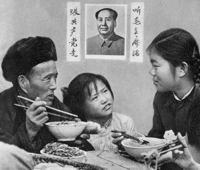
A Great Classroom for Teaching Class Struggle
Chairman Mao has said: "In order to have a real grasp of
Marxism, one must learn it not only from books, but mainly through
class struggle, through practical work and close contact with the
masses of workers and peasants." Keeping to this teaching,
these young revolutionaries of the Long March Red Guard Detachment
visited workers, poor and lower-middle peasants and old
revolutionaries and held discussions with them, taking every
opportunity to learn from them. They had more than 40 get-togethers
with old workers, old poor peasants, veterans of the Eighth Route
Army and revolutionary students. Through these activities they
learnt profound lessons on class struggle and about the
revolutionary tradition. In Chinhsien county, Liaoning Province,
they called on Ma Yu-cheng, a labour hero and an activist in
studying Chairman Mao's works. The way this old poor peasant never
forget the suffering of his class, his undying hatred for the class
oppression in the old society with its blood and tears, and his
boundless love for the Party and Chairman Mao and persistent study
of Chairman Mao's works, creatively studying and applying what he
studied, were profound lessons for these young revolutionaries. They
set their minds to be like this old poor peasant, study Chairman
Mao's works, follow his teachings, act in accordance with his
instructions and be good students of Chairman Mao.
In early September, they arrived at noon in Tashan where the famous
"Tashan Regiment of Heroes," fought the battle of Tashan
during the Liberation War. Every hill and every blade of grass here
is a mute reminder of the glorious deeds of those heroes. At the
monument erected to the revolutionary martyrs of Tashan, the
youngsters took the following solemn oath: "We members of the
Long March Red Guard Detachment will continue along the road
crimsoned with your blood, take up your guns, and go on with the
fight to complete the task you had to leave unfinished. We are at
all times ready to face all kinds of hardships, unafraid of
sacrifice, and will for ever follow Chairman Mao in revolution, so
that our great motherland shall never change colour and that we can
build our country into an impregnable proletarian state and make it
secure!"
Long-Dreamt-Of Meeting With Chairman Mao
In Peking, the young revolutionaries of the Long March Red Guard
Detachment happily met their great leader Chairman Mao whom they had
long dreamt of meeting. Li Lung-fu was invited as the detachment's
representative to go up on the Tien An Men rostrum on National Day,
and along with other representatives from all parts of the
motherland, he was received by our most, most respected and beloved
great leader Chairman Mao.
The night before meeting Chairman Mao, many were the thoughts racing
through the minds of the 15 fighting members of the Long March Red
Guard Detachment.
Sun Feng-chi, whose family were hired farmhands for generations,
thought of his father who worked as a farm labourer hired by the
year for the landlords in the old society. Those were long days of
suffering . . . the landlord's lash . . . the family scattered. . .
. It was our respected and beloved Chairman Mao who rescued the
family from the pit of fire and it was Chairman Mao who gave him the
opportunity to go to college!
Chang Huai-fa remembered the days in an orphanage in the Liberated
Areas and the first time he shouted "Long live Chairman
Mao!", the first time he sang the song Chairman Mao Is the
Saviour, and the Spring Festival when a teacher brought them new
cotton padded jackets, saying, "These are from Chairman
Mao." At that time he didn't have a relative in the world but
he looked upon Chairman Mao as his only kinsman. For years he had
been wishing and hoping to see his saviour Chairman Mao!
The thoughts running through their minds that night were both bitter
and sweet. Now their dreams through the years were about to be
realized. How could they sleep! Some got into bed, then climbed out
again to write something in their diaries and read some quotations
from Chairman Mao. All longed for the day to break.
The Long March Red Guard Detachment is now about to leave Peking to
return to their school. They firmly expressed that they will
certainly take Chairman Mao's support and solicitude for the
revolutionary masses and the revolutionary spirit and revolutionary
experience of Peking's revolutionary students and teachers back to
Talien and their school. They have also pledged to firmly defend the
proletarian revolutionary line represented by Chairman Mao and to
thoroughly criticize and repudiate the bourgeois reactionary line,
and to carry the great proletarian cultural revolution through to
the end.
|