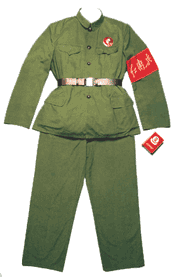

THE UNIFORMS OF THE RED GUARDS (or DRESSED TO
REVOLT)
When completed, this section will include posters,
photographs, and footage showing Red Guards in uniforms, as well as old
PLA uniforms from the 1940s.
As young middle school and university students in Beijing began to rebel
in 1966, they looked to the traditions of the 1949 Revolution, and particularly
to the army, for inspiration. One group of Beijing student rebels decided
to call themselves ‘Red Guards’, hong weibing, and
they saw themselves as soldiers (bing) who were fighting to protect
(wei) the Revolution and Mao thought (represented by the word
‘red’ or hong).
| The new
revolution of 1966 was also a nostalgic retro-revolution, one that
expressed a longing, in both Mao and the Red Guards, for a lost
era of revolutionary ardor, purity and enthusiasm. For Mao much
of the impetus of 1949 had been stymied by the stolid bureaucracy
of the socialist state—run by the men and women who were now
identified as ‘people in power taking the capitalist road.’
For the Red Guards, the educational system itself undermined the
revolution that had once transformed China; a new revolution in
education would be the start of national renewal and salvation.
In their reenactment of the 1949 Revolution, Mao's new revolutionaries
rehearsed the history of the original army controlled by the Communist
Party. During July and August of 1966, old army uniforms, broad
leather belts, arm bands and military caps became popular among
the Red Guards and other middle-school students as a sign of their
revolutionary purity, and as proof of their impeccable family background.
(Many of the Red Guard uniforms were faded because they had originally
been worn by their parents during the 1949 Revolution.) |

|
|